Close

ASCENDANT

Showcased at IGDC 2024

Trailer

Project Details

Tools Used

Unreal Engine 5 · Blueprints/C++ · Blender · Git VCS · Photoshop · Illustrator · Figma · Audition · Confluence · Trello · Discord · Google Sheets · Google Docs

About the game

Ascendant is a stealth-action adventure game set in a dystopian cyberpunk city where mega-corporations rule with iron control. Players step into the role of a skilled operative tasked with infiltrating hostile districts, eliminating key targets, and dismantling corporate tyranny from within. Equipped with advanced abilities like grappling, teleportation, hacking, and invisibility, players must outsmart surveillance systems and execute missions with precision and strategy. Each level challenges players to adapt — combining stealth, parkour, and tactical planning to survive in a city where every shadow hides danger. Ascendant delivers a high-stakes, atmospheric experience that rewards creativity, patience, and mastery of movement.

Development Time: May 2022 – Jul 2023

Project Role: Game Programmer / Systems Designer

Team Size
6 (Alpha) | 2 (Launch)
Engine Used
Unreal Engine 5.2
Genre
Third Person Stealth Parkour
Platform
PC

My Role

Developed under Gamer2Maker mentorship in Unreal Engine 5 — responsible for technical implementation and gameplay design direction.

Lead Developer

  • Architected a modular Gameplay Ability System (GAS)-style feature set in UE5 Blueprints/C++ so stealth, parkour, and abilities could iterate without monolith coupling.
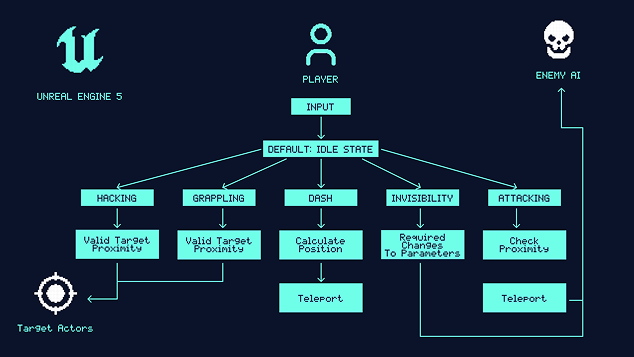
  • Implemented a hierarchical finite-state machine (FSM) for Idle, Dash, Grapple, Invisibility, Hacking, and Assassination with guarded transitions and interrupt rules.
  • Extended Character Movement Component workflows for wall climbing, sliding, and teleport dash, including root-motion timing and collision query traces.
  • Built enemy AI with Behavior Trees, Blackboards, and EQS-style perception queries for patrol, detection cones, and combat reacquire loops.
  • Profiled Blueprint hot paths — tick reduction, event-driven updates, and object pooling for ability FX — to keep framerates stable under dense AI load.
Ascendant gameplay — Lead Developer

System Designer

  • Designed data-driven mission graph / objective pipeline linking unlocks, district progression, and fail-forward stealth outcomes.
  • Built cooldown/cost resource management tables so abilities stayed readable without soft-locking infiltration routes.
  • Engineered an alarm propagation network with detector nodes, escalation timers, and reinforcement spawn hooks on detection events.
  • Integrated camera hacking as a tagged interactable subsystem feeding stealth FOV and traversal shortcuts.
  • Implemented lock-on targeting and contextual execution montages with animation notifies for reliable assassination commits.
Ascendant systems state diagram

Game Designer

  • Authored the GDD covering stealth affordances, traversal verbs, and enemy AI roles, referenced against Metal Gear Solid and Dishonored infiltration structures.
  • Defined core loops around infiltration → intel retrieval → escape, with soft-fail deterrents rather than hard mission resets.
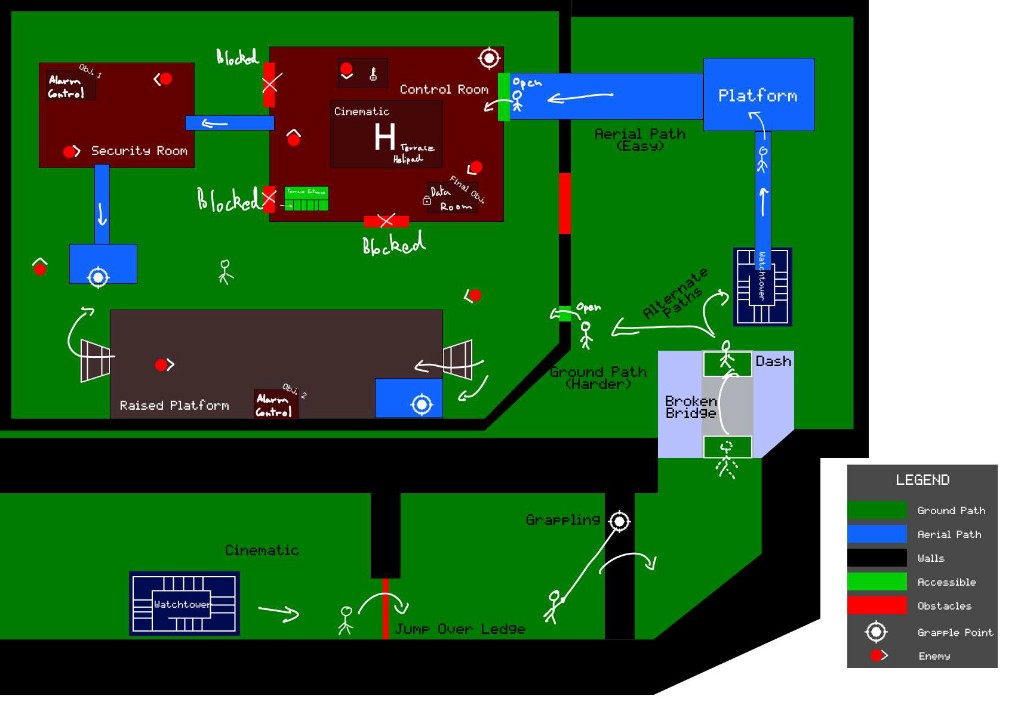
  • Designed prototype objectives: Disable Alarms → Acquire Keycard → Access Terminal → Escape the Zone as sequenced gating systems.
  • Defined difficulty curves for enemy awareness radii, patrol density, and resource scarcity across districts.
Ascendant level design layout

Tools & Technologies

Unreal Engine
Blender
GitHub
Confluence
Discord
Illustrator
Figma
Photoshop
  • Unreal Engine 5 — Blueprints/C++, hierarchical FSMs, Behavior Trees, Blackboards
  • Character Movement — parkour traces, slides, teleport dash locomotion
  • Blender — environment blockouts and asset integration
  • GitHub — branching, code review, and build checkpointing
  • Confluence — GDD, system specs, and tech documentation
  • Discord / Figma / Illustrator / Photoshop — coordination and UI/texture pass

References

  1. Nystrom, R. Game Programming Patterns — Finite State Machines and hierarchical state structure for ability modes.
  2. Isla, D. Handling Complexity in the Halo 2 AI — Behavior Tree / Blackboard control for agent decisioning (GDC).
  3. Kojima, H. / Konami — Metal Gear Solid series: infiltration affordances, alert phases, and stealth information design.
  4. Arkane Studios — Dishonored: systemic stealth verbs, non-linear objective routing, and power-cost tradeoffs.
  5. Epic Games — Unreal Engine Character Movement Component and AI Perception documentation for locomotion/query pipelines.

Workflow Summary

  • Pre-Production

    Defined narrative and stealth system flow → drafted GDD and technical documents.

  • Prototype Development

    Built and tested core systems (state machine, AI, parkour).

  • Testing Phase

    Iterated on level flow, alarm systems, and enemy AI behavior.

  • Look Dev & Lighting

    Applied cyberpunk aesthetic and visual consistency.

  • Final Build Optimization

    Debugged transitions, refined performance, prepared for playable demo.