Close

WHITE RABBIT

Personal Startup Venture

Trailer

Project Details

Tools Used

Unreal Engine 5 · Blueprints/C++ · Blender · Git VCS · Photoshop · Illustrator · Figma · Audition · Confluence · Trello · Discord · Notion

About the game

White Rabbit is a psychological action horror RPG set in a deranged amusement park shaped by corporate control, personal trauma, and a fractured sense of reality. Players take on the role of Elise as she uncovers the truth behind Mokia Corp and Project Malice through dual-world exploration, sanity-driven gameplay, and player choice. The game blends psychological horror, sanity-based mechanics, and choice-driven systems — exploring both the real world and distorted fragments of Elise’s subconscious. At its core, White Rabbit is about identity, free will, and survival: as Elise uncovers the truth, players decide whether she breaks free from Mokia Corp’s control or becomes another victim of it.

Development Time: Jan 2024 – Feb 2025

Project Role: Founder / Lead Programmer / Game Designer

Team Size
15+ (20+ across collaboration)
Engine Used
Unreal Engine 5.4
Genre
FPS Horror RPG
Platform
PC

My Role

As Founder, Lead Programmer, and Game Designer, I led the game’s vision while building core systems and shaping gameplay. I led 6 programmers and collaborated across level design, art, and marketing within a 20+ person team to deliver a playable proof of concept.

Founder

  • Founded the project and shaped its vision, direction, and production goals from concept through development.
  • Pitched White Rabbit to publishers including Soft Source and Kwalee — covering identity, timeline, scope, and market potential.
  • Defined key deliverables, production targets, and overall project direction across development.
  • Supported a 2-year development plan with a proof of concept delivered in 4 months (~$380K core cost; ~$15.5K monthly burn).
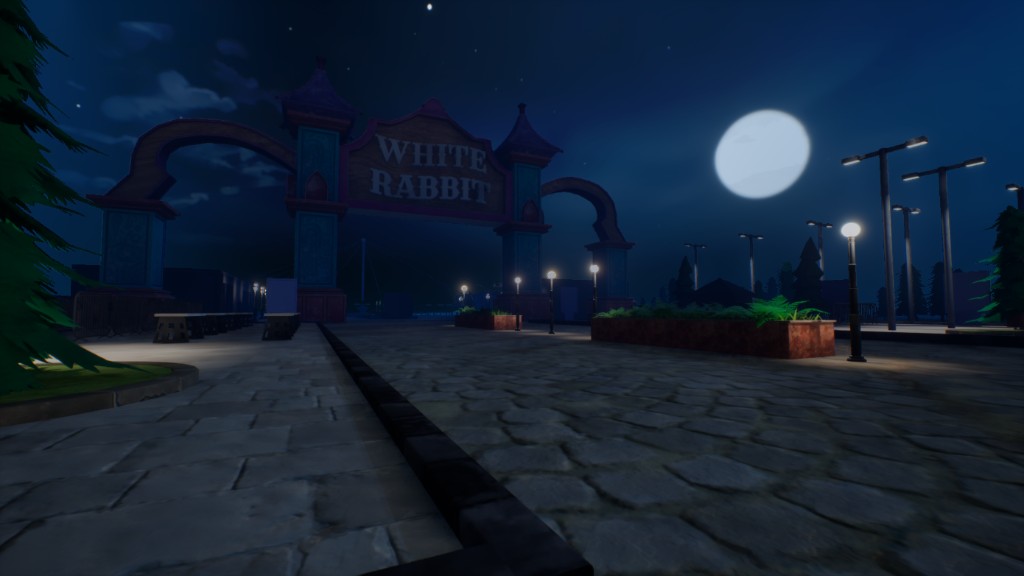
White Rabbit park entrance — Founder

Lead Programmer

  • Led 6 programmers with a shared subsystem ownership map (audio, save data, combat, inventory) tracked in Trello/Git.
  • Built runtime architecture in UE5 using Blueprints + C++ modules: player pawn, interaction interfaces, and event-driven managers.
  • Designed a zone-based audio graph with zone managers, crossfades, bus routing, and priority ducks for layered horror beds.
  • Implemented save/load via a serialized SaveGame object graph — preserving progress flags, inventory, gun/player stats, and key interactables.
  • Authored Character Movement configs, pickup/inventory containers, and animation timing tables iterated through structured playtests.
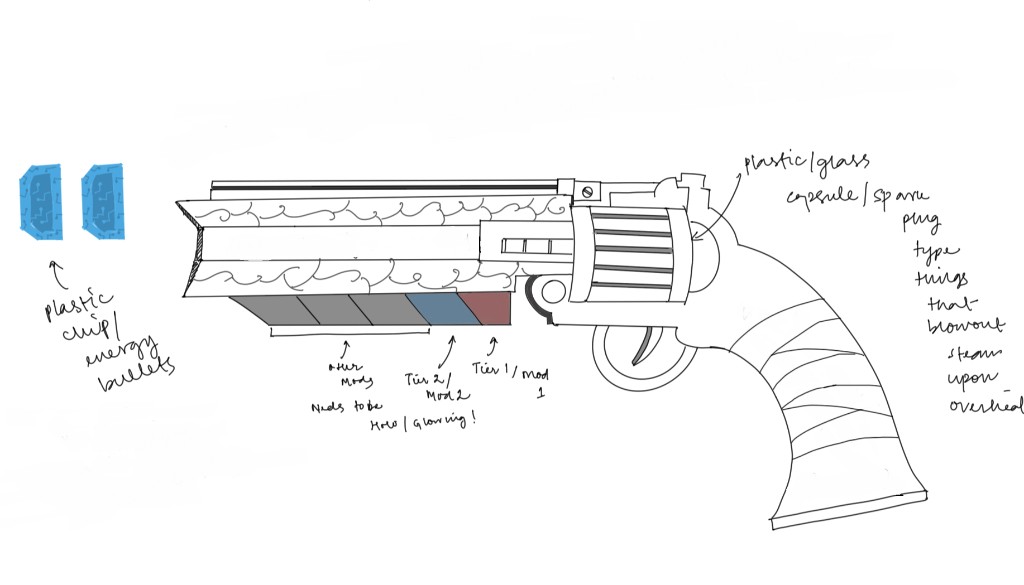
  • Modeled weapon stat pipelines (damage, spread, recoil curves, mod sockets) as data-driven structs rather than hard-coded combat branches.
  • Cut PoC footprint 14 GB → 3 GB with soft references, packed levels, light baking, and reduced per-frame casting/tick work.
Weapon concept with modular combat mods — Lead Programmer

Game Designer

  • Defined the core loop around sanity systems, moddable combat, interaction verbs, and gated progression.
  • Connected narrative branches, player choice, and gameplay systems into one design spine for the PoC slice.
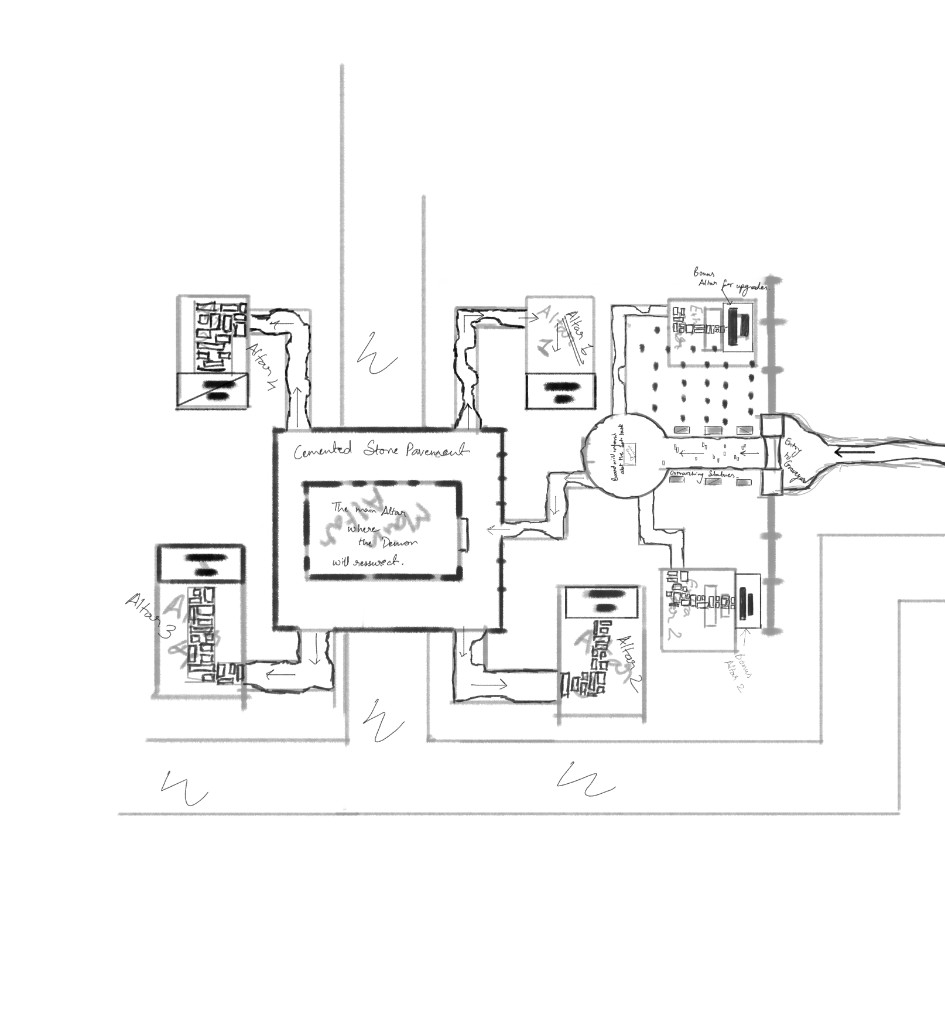
  • Contributed level design — spatial pacing, encounter telemetry goals, altar puzzle sequencing, and boss approach vectors.
  • Shaped story structure with beat charts / act ladders; tied corporate dystopia and trauma beats into mechanical beats.
Altar ritual level layout sketch — Game Designer

Tools & Technologies

Unreal Engine
Blender
GitHub
Confluence
Discord
Illustrator
Figma
Photoshop
  • Unreal Engine 5.4 — Blueprints/C++, SaveGame serialization, audio zone managers
  • Data-driven combat — weapon structs, mod sockets, recoil/spread curves
  • Blender — environment blockouts and asset integration
  • Git — version control across a 6-programmer technical split
  • Confluence / Notion / Trello / Discord — specs, tickets, and production sync
  • Figma / Illustrator / Photoshop — UI and texture iteration

References

  1. Jenkins, H. Game Design as Narrative Architecture — environmental storytelling and spatial narrative sequencing.
  2. Perron, B. (ed.) Horror Video Games — tension design, vulnerability framing, and audiovisual fear cues.
  3. Epic Games — Unreal Engine Soft Object References / Asset Manager guidance for streamed content and build size.
  4. Nystrom, R. Game Programming Patterns — event queues and decoupling for manager-driven audio/inventory systems.
  5. Schell, J. The Art of Game Design — lenses for feedback, fairness, and playtest-driven iteration on horror puzzles.

Workflow Summary

  • Pre-Production

    Defined game vision, core mechanics, narrative direction, and technical structure.

  • Systems Development

    Built and tested audio zones, save/load, player mechanics, puzzle interactions, and weapon stats.

  • Level Design & Narrative

    Contributed to level flow, gameplay pacing, mission structure, and narrative progression.

  • Testing & Iteration

    Refined systems through playtesting, debugging, balancing, and continuous iteration.

  • Final Build

    Optimized performance, reduced build size, fixed issues, and prepared the playable demo.